

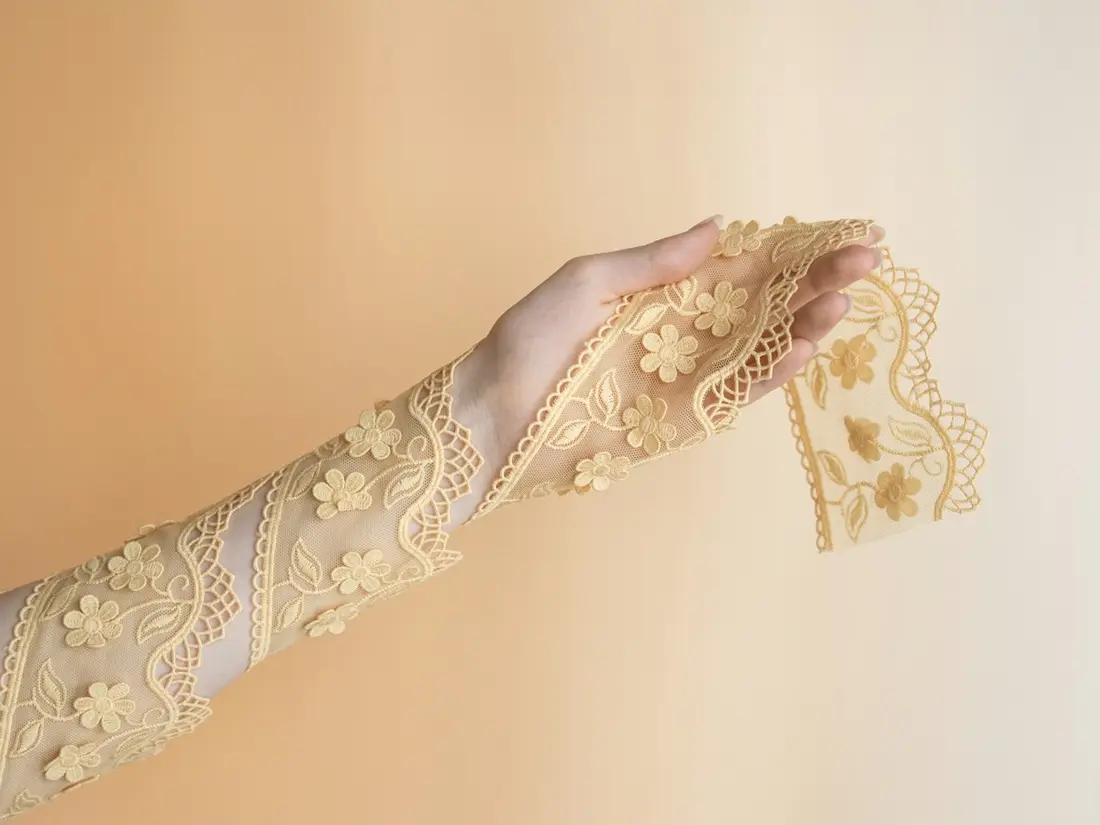
How lace is made today
Historically, lace was worked by hand, either with a needle or with bobbins on a pillow. Almost everything in the trade today is made by machine, and it usually falls into one of three groups:
- Knitted or machine-made net lace: pattern and ground are formed together on lace machines. Raschel machines work fast and produce most everyday lace. Leavers machines are older and slower, and are prized for very fine work.
- Embroidered lace: the pattern is stitched on to a base such as net or fine cotton, and the base stays in the cloth.
- Chemical lace: the pattern is embroidered on to a backing that is then dissolved, leaving only the thread work.
Two other things vary as well: the fibre, often nylon, polyester, cotton or a blend, and whether a thicker cord outlines the motifs.
Chantilly and Alencon: the classic bridal laces
Chantilly is named after the French town where it was made as a bobbin lace. Today it is usually machine made, with delicate florals on a fine, soft net ground, and a thin outline around the motifs. It has a light, flat look and falls softly, so it suits veils, sleeves, overlays, shawls and lingerie. It is often seen in ivory or black.
Alencon also takes its name from a French town, in this case one known for needle lace. In the modern trade, the name usually means florals on fine net with a heavier raised cord around the motifs, sometimes with added beads or sequins. It has more depth and body than Chantilly, and it is widely used on bridal bodices and hems, as well as being cut into motifs for appliqué.
Guipure and corded lace: pattern with more body
Guipure has no net ground. The motifs are joined directly to each other or by small bars, which gives a bold, open, slightly rigid cloth. It is typically made as a chemical lace. It works well for dresses, jackets, tops and yokes, and since there is no net to rely on, it can be cut around the motifs for a clean edge. It often has less give and can feel stiff against the skin, so it is usually lined.
Corded lace is a broad description: any lace in which a thicker yarn outlines the pattern, which makes the design stand out from the base. Alencon is one example. Ask how thick the cord is and how firmly it is held, because a loosely couched cord may catch and pull away.
Embroidered net and Schiffli
Embroidered net is exactly what it sounds like: machine embroidery on net or tulle, sometimes with thread work, cord and sequins all on one piece. It is a staple of lehengas, gowns, blouses and dupattas, and it can be made in any shade, density or scale of pattern. For a comparison of net against its nearest rival, see net or organza for a dupatta.
Schiffli is named after a kind of embroidery machine, from the Swiss German word for little boat, which describes the shape of its shuttle. Many needles stitch the same pattern across a wide piece at once. The term covers embroidered cotton voile with eyelets as well as chemical laces made on these machines. So when you hear the name, ask whether a base remains and what it is.
Cord lace and sequin lace for African and party wear
In West African trade, and in much of the party wear business, cord lace generally means a heavily corded lace with bold motifs, in strong colours or metallic tones, with a firm hand and a real presence on the body. It is widely used for weddings and ceremonial outfits, including the coordinated group outfits called aso ebi in Nigeria, and is often sold in pieces of a set length, commonly 5 yards. Confirm the length when you buy, and do not assume a piece is cut to order.
Sequin lace uses a net or corded base with sequins stitched into the motifs or scattered over it. Sequin size, density and finish vary a lot. Match sequins and base carefully, as a heavy load of sequins on a thin net can sag or tear at the seams. Many tailors remove sequins along the seam line before stitching.
What to check when you buy lace
- Repeat: ask for the length of one pattern repeat. A large repeat looks grand but creates more waste, because motifs must match across seams and panels.
- Width: lace can be a narrow trim, a galloon that is wider with a finished edge on both sides, or a full allover cloth. Confirm the usable width, not including any waste edge.
- Base: feel whether the net is soft or stiff, and look for holes, pulls and dropped threads. Ask for the fibre too. If motifs and net are different fibres, they may take dye differently, so check the match on the actual lot.
- Edge: check whether the edge is scalloped on one side, both sides or not at all. Scalloped hems and necklines depend on this, and an edge that is too narrow will not work for a border.
- Back of the cloth: look for long loose threads, and tug lightly on cords and sequins to see how they are fixed.
- Shade and shrinkage: match shade against your lining, and if it is a cotton lace, test a piece for shrinkage. See our fabric quality checklist for the rest.
Since lace names vary from place to place, describe what you need instead of relying on one word: base, motif, cord, sequins, width and shade. Post a fabric requirement with those details and your quantity, whether small or bulk. Nobody's name or number is shown until both sides agree. If you hold lace, you can list it for sale with the same details and close-up photos.
Questions
What is the difference between Chantilly and Alencon lace?
Both usually have florals on fine net. Chantilly has a thin outline and a light, flat look that drapes softly, while Alencon has a heavier raised cord around the motifs, which gives more depth and body.
What is guipure lace?
Guipure is a lace with no net ground. Its motifs are joined directly or by small bars, and it is usually made by embroidering on a backing that is then dissolved. The result is bold, open and firmer than net based laces.
What is cord lace used for?
Cord lace is widely used for party wear and for ceremonial outfits, especially in West Africa, where it is popular for weddings and group outfits. Its heavy outlined motifs give it a strong presence, and it is often sold in pieces of a set length.
What should I ask before buying lace in bulk?
Ask for the repeat length, usable width, base fibre and softness, and the edge type, then get a photo or swatch of the actual lot. For sequinned or corded lace, also check how firmly the decoration is fixed to the base.